



It seems that summer will arrive even earlier this year than in other years. And summer brings with it many joys—vacations, swimming, camping, barbecues, and sunbathing. In addition, a wide variety of fresh fruit will start appearing on our tables. Not all of it can be eaten just as it was picked, and we often want to use it to make salads, compotes, or desserts. That’s why we simply need high-quality Mikov knives for our fruit.
So, can we use just any knife to cut fruit? Basically, yes, but depending on the type of fruit we’re working with and what we need to do with it, it’s better to use a specialized knife. For regular use in the kitchen, where a lot of work is done with fruit, Mikov definitely recommends using several different types of knives.
For cutting larger fruits, such as pineapples or melons (even though, from a horticultural standpoint, a melon is actually a vegetable), a large chef’s knife is ideal, because its length and weight allow you to easily and safely cut even larger pieces. Among its large kitchen knives, Mikov offers the chef’s knife from the RUBY set, the KLASIK chef’s knife, the RUBY Santoku, and the KLASIK Santoku.
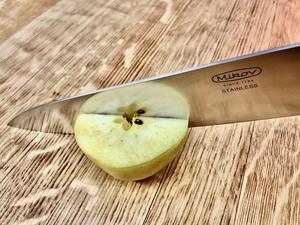
For medium-sized fruits, such as apples or pears, a utility knife is suitable. It is smaller than a chef’s knife but still has a blade long enough to make cutting easier and faster. Mikov offers this knife in either the luxurious RUBY or KLASIKset . The RUBY set also includes a fruit knife, which has a slightly shorter blade and is specially designed for cutting fruit.
A small but sharp knife suitable for peeling, cleaning, and finely slicing smaller fruits, such as strawberries or kiwis, is the paring knife. Its small, sturdy blade allows for precise and detailed cuts, which comes in handy when preparing fruit—for example, to decorate desserts or fruit cups. And once again, it’s up to your preferences whether you choose theluxury Ruby peeling knife or the KLASIK peeling knifefrom Mikova’s selection .
And if you’re wondering how best to slice fruits that have a firmer skin and a soft interior—such as peaches or tomatoes (tomatoes are also vegetables :-))—use a bread knife with a serrated edge. It’s precisely the serrated blade of the RUBY bread knife or the KLASIK bread knife that reduces the risk of squashing the fruit.
Whichever option you choose, it’s always important to keep your knives sharp, because a dull knife will crush the fruit instead of making a clean cut. That’s one of the reasons we’ve prepared instructions on how to sharpen your knives properly.