



We recently received a question from one of our customers asking what washers Mikov uses on the Predator knife. And it’s an important question. We usually focus on what’s visible at first glance—the blade, the scales, or the guard. But there are other components on a knife as well. They’re hidden, inconspicuous, and yet, if they were missing, the knife wouldn’t function properly. The washer is a typical example.
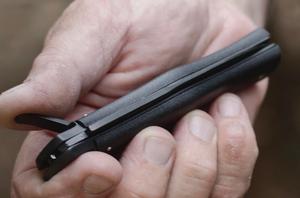
Spacers, as we know them today—that is, simple metal rings—began to appear with the development of industry, mainly in screw connections. Over time, however, it was discovered that when used in folding knives, they make the knife easier to open and reduce wear and tear. These washers, located at the pivot point around which the blade rotates, are typically made of steel, bronze, ceramic, or Teflon. And it is precisely these that Mikov uses in its knives.
Teflon, polytetrafluoroethylene (PTFE), was discovered by accident in 1938 by Roy Plunkett of DuPont while experimenting to find a new refrigerant. During World War II, Teflon was used in the military industry, primarily to coat seals and valves in equipment exposed to aggressive chemicals and extreme temperatures. Teflon washers were not introduced into knives until the 1980s.
The main reason Mikov chose Teflon liners is that they have a very low coefficient of friction, which ensures smooth opening and closing of the knife. This is important for all knives, but especially for the Predator switchblade. Teflon is also resistant to corrosion and chemicals; it is very lightweight, absorbs vibrations well, and requires no maintenance.