



The first answer to this question might be that it’s primarily a matter of design. Paradoxically, however, that’s not the case. The elegant black design of the blade is actually just a side effect of the DLC coating applied to all the knife’s metal parts. And even though DLC coatings are also produced in other colors, black is the standard color.
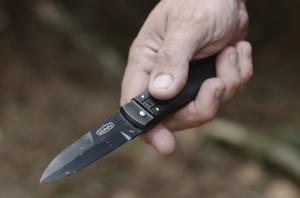
The DLC (diamond-like carbon) coating is composed of carbon, which is either configured as graphene (in the sp2 configuration) and has excellent lubricating properties, or is configured as diamond (in the sp3 configuration), which ensures hardness (microhardness exceeds 30 GPa).
The properties of the DLC coating make it ideal for use on high-stress cutting tools, from which it was then adapted for knives. Hunters, in particular, appreciate the low light reflectivity—which is less than 4%—meaning there is no risk of being spotted during a hunt due to glare from the blade.
But the list of DLC’s positive properties doesn’t end there. A knife with this coating has high surface tension, so dirt doesn’t stick to it, and, most importantly, the DLC coating is completely corrosion-resistant. The coating cannot be practically removed from the knife—only through very expensive plasma etching methods—and is therefore resistant to solvents and corrosive substances.
So far, Mikov has released only the luxury Pocket knife series with a DLC coating, in addition to the Predator Blackout. One reason for this is that the exceptional properties of knives treated in this way are offset by a relatively significant increase in price. The Predator Blackout therefore costs twice as much as the Predator Stonewash, which is made from the same N690 steel. Under normal use, the average user won’t notice a difference, yet the Predator Blackout remains very popular among customers for its design.