



Behind the mysterious name “Martfrost” lies Czechoslovak patent No. 119692, filed by Czech metallurgy expert Jaroslav Jech. The essence of the patent is that the steel is heated to a hardening temperature of 1050° –1100°C, then cooled in water to 250 to 300°C, and immediately transferred to a freezing bath of nitrogen vapor.
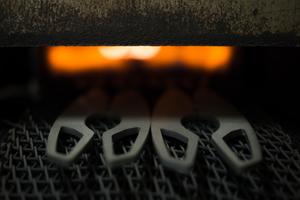
The name of the process itself is derived from this procedure. “Mart” is the first part of the term “martensite,” which is a highly hard and strong supersaturated solid solution of carbon in iron that forms during quenching by rapid supercooling. “Frost” refers to freezing.
The result of this quenching process is that the material has a hardness 5 or more HRc units higher than with conventional quenching. Not only that, but its wear resistance is also enhanced. When used on a knife, this not only gives it greater flexibility, hardness, and toughness, but also extends the blade’s durability.
Mikov used this hardening method from the 1970s through the 1990s. He applied it primarily to kitchen knives, hunting knives, and UTON military specialty knives. However, since modern stainless steel has approximately the same properties as the earlier steel from SONP Kladno hardened using the Martfrost method—and because this method caused significant environmental impact—Mikov abandoned this hardening technique.
Nevertheless, the practice of freezing steel after hardening has not disappeared into the mists of time; specialized departments at some companies still use it.