



That's true, but not entirely. The quality of a knife is primarily determined by its blade. For the blade to last and prevent the knife from quickly becoming dull or breaking, the material must be not only hard but also tough—that is, resistant to plastic and elastic deformation.
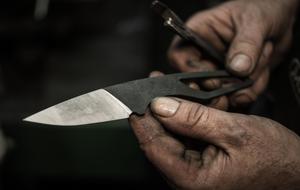
In steel, both of these properties depend on many factors. First and foremost is its chemical composition, but also the method of melting the raw materials, forging or rolling, and finally heat treatment (hardening and tempering).
The hardness of materials can be measured in various ways. For knives, the Rockwell scale is most commonly used, denoted by the abbreviation HRC (the letters A and B are used for measuring softer materials). Hardness is measured by pressing a diamond cone into the material. A force of 1471 N must be applied, and the depth of the indentation is then measured. In knife brochures and promotional materials, for example, we often read that the steel of a knife has a hardness of 57 HRC.
It might seem that the harder the knife, the better. But that’s not the case—for some knives, excessive hardness is unnecessary and even undesirable. Furthermore, very hard materials often lack toughness. The hardness rating alone (e.g., HRC 60) is therefore not a guarantee that the knife is high-quality and durable. It could also be a brittle knife that is, moreover, very difficult to sharpen.
And what types of steel does Mikov use for its knives? 420 stainless steel (HRC 52–55), for example, for the Stovkafolding knives or Fixir hunting knives; martensitic stainless steel DIN 1.4116 (HRC 55) for the Ruby kitchen knives, Damascus steel (HRC 57–60) and RWL 34 steel (HRC 57–60) for the Predator and Jaguar knives, and finally N690 steel from Bohler (HRC 57–60) for the List, Patron, Pocket, Predatory Stonewash, and Blackout knives.