



Several locking systems are used to prevent folding knives from closing on their own. In our blog, we’ve already discussed the backlock system, which is best known from Fixir hunting knives. Today, we’d like to take a look at a second system—the liner lock.
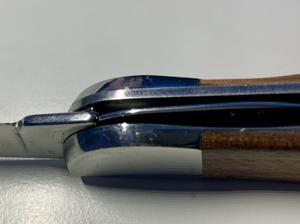
This locking mechanism was invented by American knife maker Michael Walker in the 1980s. Unlike the backlock, it does not require a button on the outside of the knife’s spine; the lock is built into the knife itself.
It works by having a metal strip, called a liner, inside the knife. This liner is tensioned when the knife is opened, and once the knife is fully open, it locks against the end of the blade inside the handle. When you want to close the knife, simply slide the liner to the side, and the blade is released.
In our knives, you’ll find the liner lock mechanism, for example, in the Praktik folding knives or the elegant Hiker outdoor knives.
Each locking system has its pros and cons. When using a liner lock, keep in mind that releasing the lock requires a bit more precision and finesse than with a back lock, where the lock is released simply by pressing the palm against the spine of the knife’s handle. On the other hand, the advantage is that the blade cannot be accidentally released during rough handling of the knife.