



Cooking, grilling, baking, and other kitchen tasks are a hobby and a source of joy for many of us. But the kitchen is also a place where you need to be careful, as there is a risk of burns, scalds, or even very painful cuts from kitchen knives.
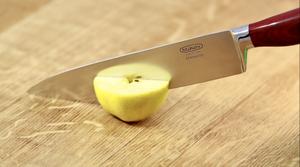
Watching professional chefs—for example, as they slice onions—is almost an artistic experience. Based on our experience, we’ve therefore compiled ten principles for you to follow when working with a knife.
- Use a knife designed for the specific task. Slicing bread? Use a bread knife. Cutting steaks? Use a steak knife. In our selection of kitchen and butcher’s knives, as well as our luxury Ruby knives, you’ll find the perfect knife for every kitchen task.
- Keep your knives sharp. A dull knife is not safer; on the contrary, it can pose a much greater risk. You can find instructions for sharpening knives here. Use a sharpening steel to “refresh” the blade.
- If a knife shows any signs of damage, have it professionally repaired or take it out of service.
- Always cut on a stable and firm surface.
- Be very careful when washing knives. Use only lukewarm water, not hot water. Hot water dulls knives, which is why they should not be placed in the dishwasher. After washing, dry the knife thoroughly and do not leave it wet for an unnecessarily long time.
- Immediately after use, return the knife to its place; never leave it lying around where it could fall.
- If a knife falls, never try to catch it mid-fall.
- Do not use a knife as a can opener, pry bar, or screwdriver—in short, do not use it for anything other than its intended purpose.
- Do not carry it together with other tableware, such as by placing it loosely on a plate, cutting board, or similar surface.
- When working with a knife, do not joke around or engage in emotionally charged arguments.