


For many people, steel is just some kind of iron, and that’s all they care about. But then there’s a group of experts, which definitely includes knife enthusiasts. And they know full well that steel isn’t just iron—it’s iron with an admixture of carbon, which must not exceed 2.14%. How hard and durable steel is also depends on what other elements are mixed in. So let’s take a look at N690 steel, which we use, for example, in some of our Predator, UTON 008, List, and Patron knives, as well as in the Pocket designer set and the Storm knife from the War Veteran Project.
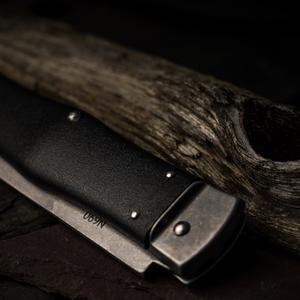
N690 steel is manufactured by Böhler, a brand of the Voestalpine Group. The company supplies it for knife production in the form of hot-rolled sheets. The key properties of this steel are hardness and wear resistance, which are primarily due to its carbon content of 1.07%.
N690 is also a stainless steel. This is particularly important for outdoor and military knives. All steels containing more than 13% chromium are stainless. N690 contains 17.3% chromium, and in addition to protecting it against corrosion, chromium also increases its tensile strength and edge retention.
After hardening, N690 steel reaches a hardness of up to 60 HRc, which is excellent; however, sharpening such a knife is by no means easy. It is nearly impossible to do so at home, which is why we recommend entrusting the sharpening to professionals.
However, in addition to hardness and wear resistance, strength is also important in knives. In N690, this strength is provided by the added molybdenum and silicon. To ensure that all the steel’s properties are optimized, the carbon, chromium, and molybdenum are present in an ideal ratio. If you’re interested in the exact percentages of each element, you can check the manufacturer’s website.
And for the steel in the final knife to possess all the required properties, it also depends on how it is processed during production—and especially whether the manufacturer’s precise specifications for hardening it in a special continuous hardening furnace are strictly followed. We, of course, have such a Swiss-made furnace available at Mikov, and we strictly monitor the process to ensure that no deviations occur during hardening.