



It’s not quite a knife, it’s not quite a sword—it’s a type of bladed weapon that can be classified within the relatively broad group of so-called machetes. Large bladed weapons designed for work emerged independently all over the world. Our Guru has its roots in Nepal, where the kukri knives originated among the Gurkha mountain people.
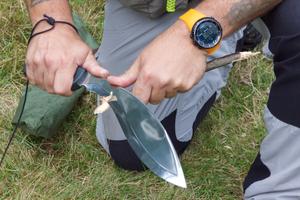
Some historians suggest that the kukri was inspired by the swords of the famous military leader Alexander the Great during his campaign in northwestern India, which culminated in 326 BCE with the Battle of the Hydaspes River (today Jelam, a tributary of the Indus). In any case, it was the Gurkhas—tough and tenacious warriors who have been part of the British Army’s elite units for over 200 years—who made the kukri famous throughout the world.
The blade of this massive and heavy weapon, with its concave edge, is first and foremost an ideal weapon for chopping, stabbing, striking, slashing, or using its flat side to stun an enemy.
Fortunately, we no longer use knives for combat in our part of the world, but for the Gurkhas, the kukri is useful not only in war—it’s perfect for clearing a path through overgrown terrain, harvesting crops in the fields, for hunting, or for preparing firewood—and this can serve as a good source of inspiration even for our Central European conditions—whether hiking through the woods, helping out during a get-together with friends, or even for working in the garden.